
How exclusive should your community be?
What we’re unpacking today:
Community should be inclusive... but also exclusive. There’s tension! We get into it!
Mom groups: the good, bad, and ugly
How to include parents in your community culture, without leaving non-parents out
In case you missed it: It’s been a minute, but we’re back. We—Carrie and Kelly from Team CMJ—use these newsletters to explore trends, tensions, and issues related to community building (and those em-dashes are human-written; no AI is used in creating these newsletters).
We share more about our goal for these conversations in our “community newsletter experiment” post.
KELLY: I’m fresh back from maternity leave and have missed these chats with you, Carrie. (Here’s our last one!) A lot has changed for me this year, but one thing that surprised me while I was away was how much I thought about community and exclusivity. Since becoming a mom, I’ve joined more WhatsApp communities than ever before. I’m grateful because I need the support—a place to ask about sleep regressions, meet neighbors, sell my old stuff, and, most importantly, find camaraderie.
But parents are obviously not the only people who need this kind of connection. At one point, I remember joining a local moms-only Facebook group expecting to find free baby stuff, mom-related resources, and so on. Instead, what I saw inside were regular neighborly conversations that anyone could participate in, parenting or not. Folks were asking intimate questions about their relationships, sharing recommendations for home contractors, and connecting over neighborhood and community resources. I was like, “Wait, why did I have to become a parent to join this group?!” The gatekeeping felt unfair.
Yet as Priya Parker teaches, events (and communities) are not supposed to be for everyone.

But how do we know how exclusive to be (or not be) with our communities?
CARRIE: I love Parker’s concept of mindful exclusion. It’s necessary to exclude with intention, not only for community members but also for organizers, so you can focus your time and energy wisely.
But ESPECIALLY when it comes to communities for and with parents, that exclusion is almost never mindful. There is usually an undertone of superiority: “If you’re not a parent, you wouldn’t understand.” And then a multitude of feelings get brought up for non-parents: maybe they DGAF, feel excluded, or are attempting to become a parent and struggling to conceive or adopt (been there; the "parent-only" exclusion is especially painful during that period).
KELLY interjection: Ugh, SAME.
CARRIE: Here’s the thing: I can imagine that the moms' group started with the intention of being a resource for moms, but then it spread out and they didn’t come back to their purpose and realign. This seems benign, but the impact isn’t. It leads to missed opportunities for connection, confusion, and likely a bit of a clique culture. As organizers, we’ve got to return to our purpose! We usually suggest returning to it at least every year.
KELLY: It really does always come back to purpose. I just saw a great example of this on Parker’s feed where she highlighted Daddy Stroller Social Club, a club where dads go on stroller walks to “bring awareness to postpartum depression in dads through community building, education, and wellness services.” It's clear here: this community is for dads because the purpose is about bringing awareness to postpartum depression in… dads. When asked if moms can join, Daddy Stroller Social Club gives a “gentle no,” which makes sense!
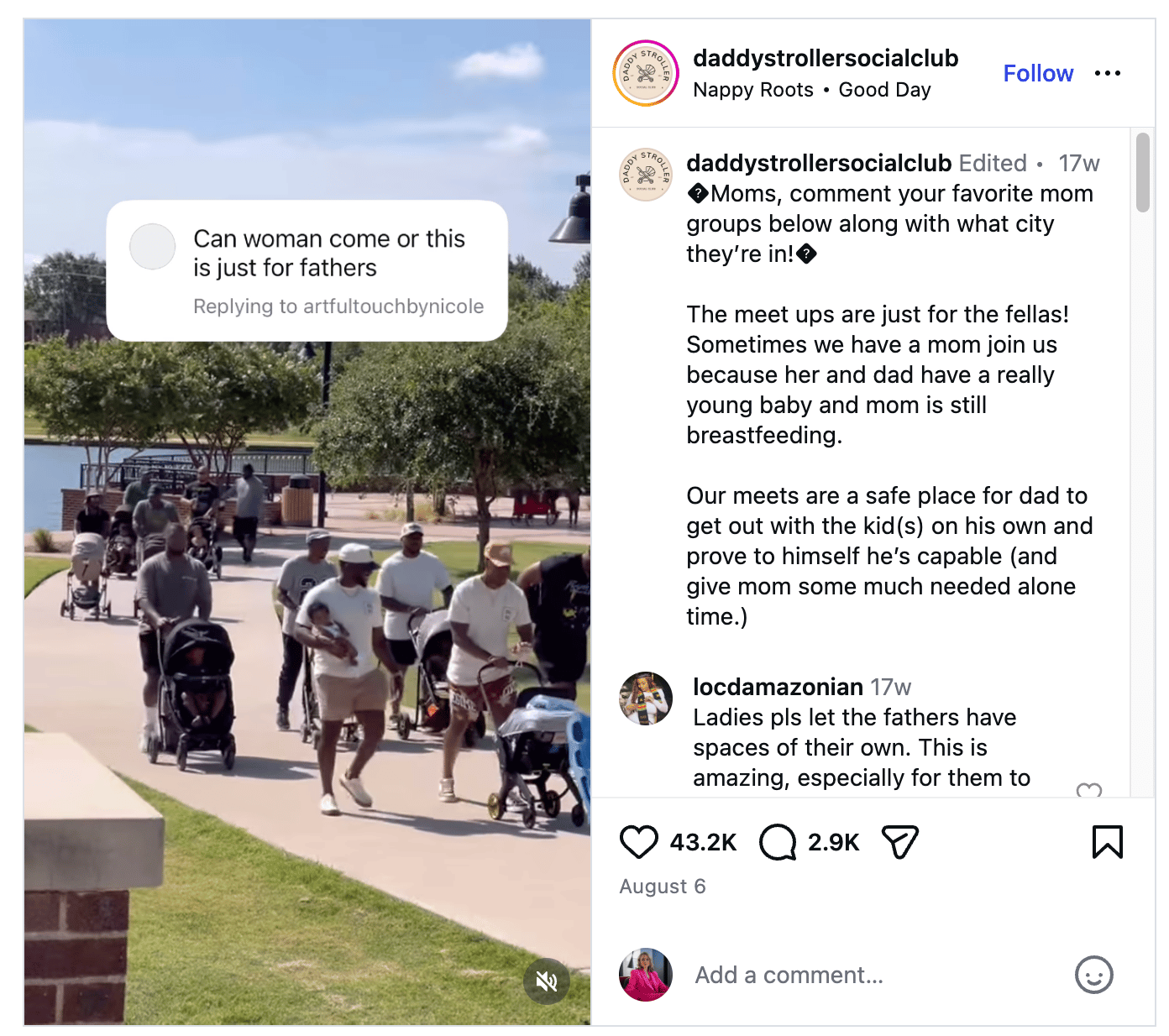
Image of Daddy Stroller Club on Instagram
We always spend a lot of time with clients defining their Community Compass (our special formula for clarifying your purpose), which means getting super specific about:
Who you gather
What they’ll do together (this is the real toughie)
and Why
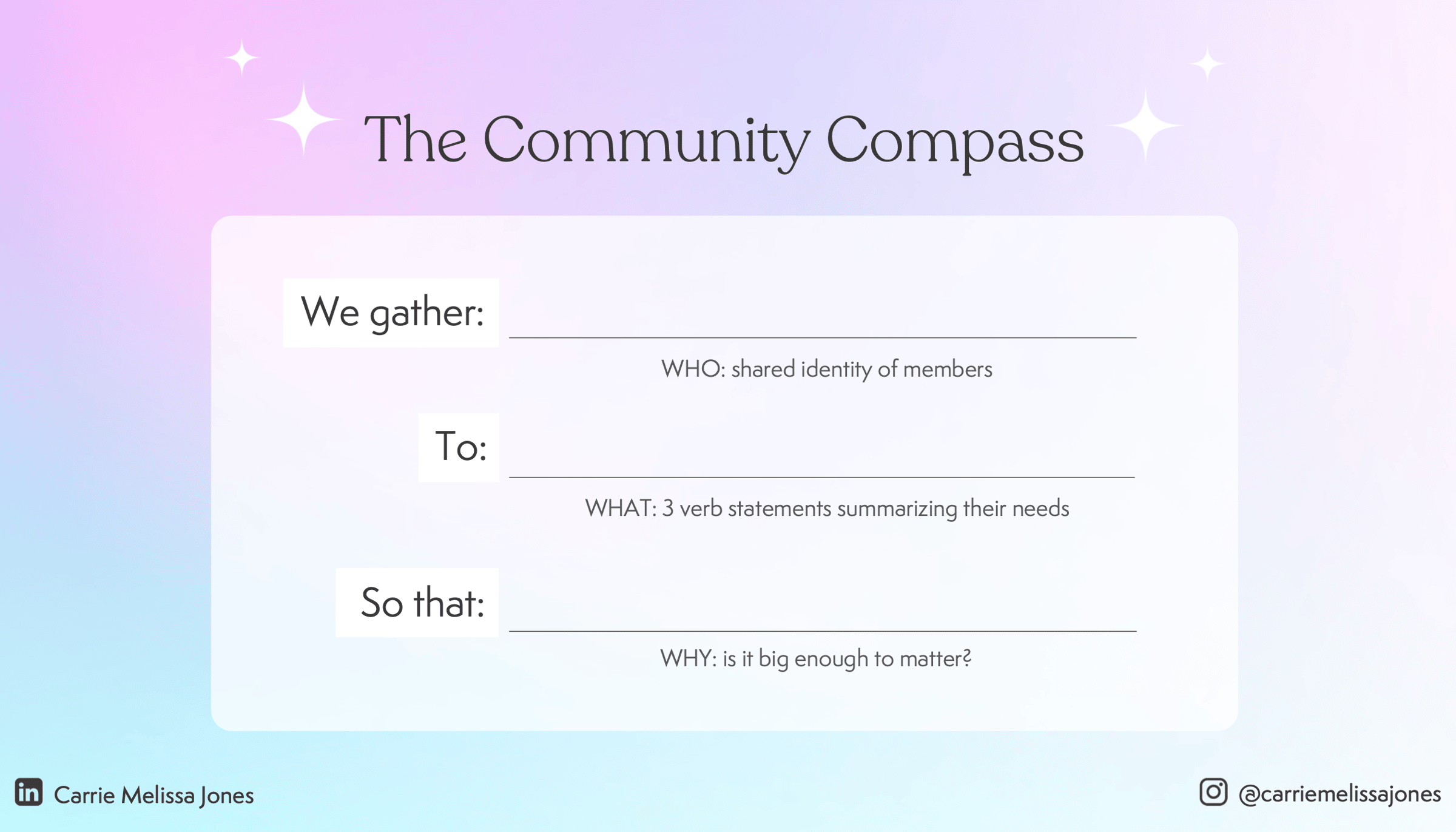
The Community Compass™ framework
Being specific and intentional with that “who” statement is so important. Have you seen other examples of communities successfully practicing mindful exclusion with a clear compass?
CARRIE: We’ve done it and are in the process of doing it again for the CMJ Community. We started by serving in-house Community Managers through leadership courses. Now we are really geared toward membership and community builders. The pressures are different, and there are few spaces not filled with BS and get-rich-quick schemes for these people. They’re also able to move faster than our former core audience. We don’t exclude in-house CMs these days (in fact, there is so much transferable knowledge between these groups), but our core has shifted. It’s not easy, and maybe not always as clear as it should be. But you’re turning a cargo ship, not a jet ski. You don’t want to give people whiplash.

So tell me about your favorite communities you’ve found during this transition into parenthood. What are a few things they’re getting right that other types of communities should learn from?
KELLY: Peers at the yoga studio where I took prenatal yoga started a moms’ WhatsApp community for people to join after giving birth. The space is well organized by topic—Childcare Questions, Free Stuff, Breastfeeding Support, Main Group Chat, etc.—and it’s active. When the person doing most of the moderating moved to another state, a few moms volunteered to take over as admins, and they arrange monthly in-person gatherings as well as help other moms find and join the group. I’ve loved the opportunity to get together with folks in person, as well as ask panicked questions about my infant in a safe space. The group feels extra helpful because:
it’s easy to navigate with clear and useful topic areas
there’s a regular cadence of family-friendly get-togethers each month (I love both the structure and the in-person bonding)
the culture is warm, welcoming, and supportive
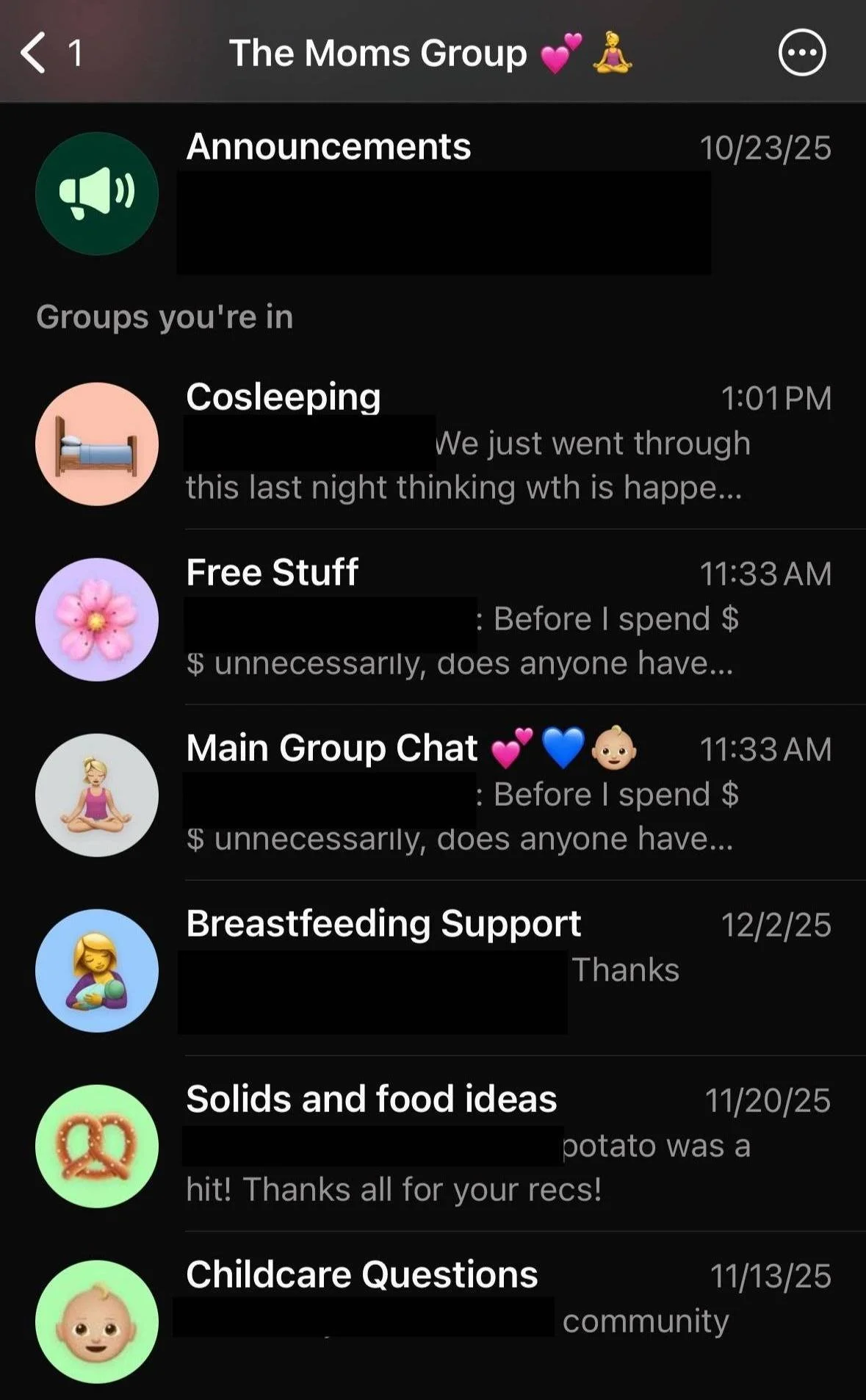
A lil preview of Kelly's prenatal yoga moms' WhatsApp group
Have you seen non-parenting spaces pull off something similar?
CARRIE: Yes, though it’s rare. What’s unique about parenting communities is that you’ve got a group of people going through a shared life transition, with urgent needs, and a desire for safety from the judgments of the outside world. It’s the perfect recipe for an active community.
🎯 If non-parenting groups take away only one thing from these well-run parenting communities, it should be this: Find the point of painful transformation that your members want to commit to, and cultivate a space to practice through it. 🎯
Mindfully exclude not based on identity, but on who is ready, willing, and non-judgemental enough to go on the transformation journey alongside others. You can have lurkers, but your community’s culture will be shaped by those who are most vocally driving change.
KELLY: I love that, and I’d love to see more family-friendly spaces designed for parents and non-parents to come together alongside each other. In new motherhood, I need friends more than ever, and I’m on the lookout for ways to include kids in get-togethers without necessarily centering them. I’m grateful that our community work has given me a useful lens to think about these things, because I need a village—with all kinds of people in it!—more than ever.
Have thoughts on parenting communities or community exclusiveness? Comment below. We love hearing from you.

Want to support our work and deepen your impact as a community builder? Join the CMJ Community today.